Turnover Tax (TOT) vs Income Tax in Kenya: Which Is Better for Your Business in 2026?
By Britax K Consulting | Tax Advisory, Compliance & KRA Tax Services
Last reviewed: 27 October 2026
Introduction: Should Your Kenyan Business Pay Turnover Tax or Ordinary Income Tax?
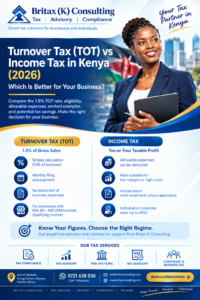
If you run a shop, a hardware business, a salon, a small distribution company, an online business or another qualifying enterprise in Kenya, one tax decision can make a meaningful difference to how much money remains in your business: whether to pay Turnover Tax (TOT) or opt for the ordinary income tax regime. Many business owners assume that Turnover Tax is automatically cheaper because the rate is only 1.5%. Others believe that ordinary income tax is always more expensive because some businesses pay tax at rates of up to 30% or more. Both assumptions can be misleading.
The real question is not simply which tax rate is lower. It is whether tax on your gross sales or tax on your taxable profit produces the better result for your particular business under Kenyan law.
A retailer buying stock for resale, a small manufacturer with substantial production costs, and a service business with few operating expenses can have very different outcomes, even when they report the same annual sales. Under Kenya’s current Turnover Tax framework, qualifying resident businesses with annual turnover exceeding KSh 1 million but not exceeding KSh 25 million are generally within the TOT regime. The tax is charged at 1.5% of gross sales. However, the law excludes certain income, including rental income and management, professional and training fees. A qualifying taxpayer may also elect in writing to the Commissioner to use the ordinary income tax provisions instead. Source: Kenya Revenue Authority (KRA), Turnover Tax.
This guide by Britax K Consulting explains how the two regimes work, their advantages and disadvantages, the effect on business cash flow and savings, and how Kenyan taxpayers can make an informed decision.
1. What is Turnover Tax (TOT) in Kenya?
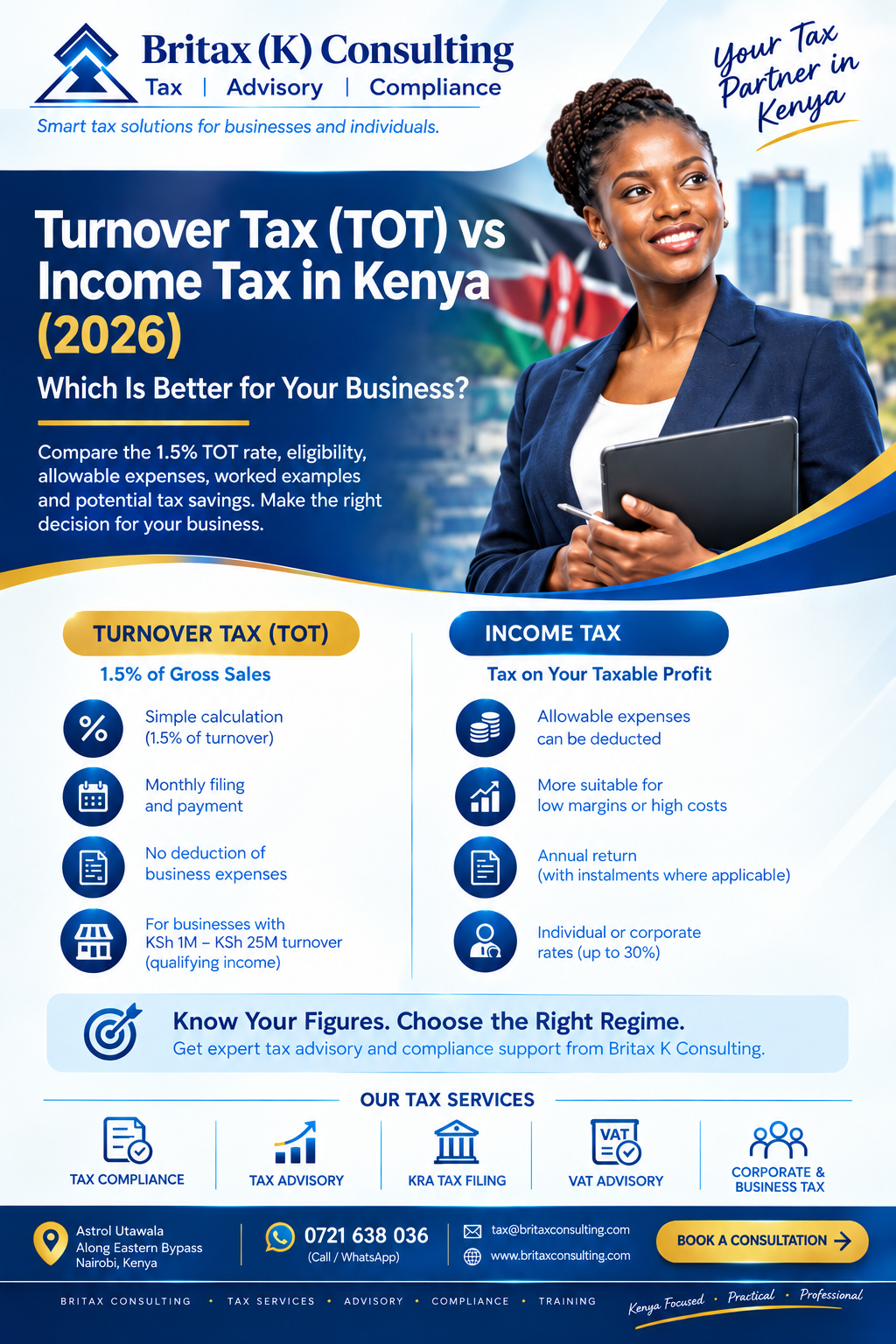
Turnover Tax is a simplified income tax regime established under Section 12C of the Income Tax Act, Cap. 470. It is designed for qualifying businesses within a specified annual turnover range. Instead of calculating tax on the profit remaining after allowable business expenses, a TOT taxpayer pays tax based on gross business sales. The current rate is 1.5% of gross sales, effective from 1 July 2023.
Who qualifies for TOT?
A business may fall within the TOT regime where:
- It is a resident person or resident company carrying on a business in Kenya.
- Its annual gross turnover is more than KSh 1,000,000.
- Its annual turnover does not exceed, and is not expected to exceed, KSh 25,000,000.
- Its income is not within the categories specifically excluded from TOT.
The exclusions are important. TOT does not apply to rental income, management or professional fees, training fees, and income subject to final withholding tax under the Income Tax Act. Non-resident taxpayers are also outside the ordinary TOT eligibility rules. For example, a qualifying small retail shop with annual sales of KSh 4 million may be eligible. A consultancy earning professional fees should not assume it can use TOT simply because its revenue falls below KSh 25 million.
Important: Turnover alone does not determine eligibility. The nature of the income and the applicable statutory provisions must also be considered.
How is TOT calculated?
The basic calculation is:
Turnover Tax = Gross sales × 1.5%
Suppose a qualifying business records the following sales:
| Particulars | Amount |
|---|---|
| Monthly gross sales | KSh 300,000 |
| TOT rate | 1.5% |
| Monthly TOT payable | KSh 4,500 |
| Annual gross sales, assuming consistent monthly sales | KSh 3,600,000 |
| Annual TOT payable | KSh 54,000 |
The business pays KSh 54,000 in TOT for the year, assuming the stated sales are the relevant gross turnover and there are no adjustments affecting the calculation. Notice that the tax does not change merely because the business’s rent increases, its suppliers charge more, or its profit margin falls. TOT is calculated on gross sales, not the amount left after expenses.
When is TOT filed and paid?
TOT is accounted for monthly. Under the current KRA guidance, the return must be filed and the tax paid on or before the 20th day of the month following the tax period. For example, TOT for October 2026 is due by 20 November 2026. Taxpayers should confirm their obligations and any applicable penalties using the latest KRA guidance. Monthly filing and payment obligations remain important even when business is slow.
Official reference: KRA Turnover Tax (TOT).
2. What is ordinary income tax for a Kenyan business?
Ordinary income tax is calculated on taxable income rather than simply applying a percentage to gross sales. For a business, the starting point is generally its business income, less allowable expenditure incurred wholly and exclusively in producing that income, subject to the Income Tax Act and applicable documentation requirements. The result is taxable profit, which is then taxed according to the rules applicable to the taxpayer. There are two common situations.
A. Sole proprietors and individuals in business
A sole proprietor operates the business as an individual. The taxable business profit is included in the individual’s taxable income and taxed using the applicable individual income tax bands, taking account of available reliefs and other relevant circumstances. KRA’s published individual income tax bands include rates of 10%, 25%, 30%, 32.5% and 35%, with resident personal relief of KSh 28,800 annually, subject to the applicable rules.
The actual tax depends on the taxpayer’s total taxable income, allowable deductions and reliefs. If the owner also earns employment income, the combined position can affect the amount of tax attributable to the business. Official reference: KRA Individual Income Tax.
B. Limited companies
A Kenyan resident company generally pays corporation tax at 30% of taxable profits, subject to applicable incentives, exemptions and special tax provisions. A company with KSh 10 million in sales and KSh 8 million in allowable business costs would, in a simplified illustration, have taxable profit of KSh 2 million. At the general 30% corporation tax rate, the illustrative corporation tax would be KSh 600,000 before considering any other relevant adjustments. The same business would calculate TOT differently if it qualified for that regime: 1.5% of KSh 10 million would be KSh 150,000.
However, the example does not mean every company with those sales can choose TOT. The company’s activities, income type and statutory eligibility must first be checked. Official reference: KRA tax information on Corporation Tax.
3. TOT vs ordinary income tax: The main differences
| Comparison | Turnover Tax (TOT) | Ordinary income tax |
|---|---|---|
| Taxable amount | Gross business sales | Taxable profit |
| General rate | 1.5% | Individual progressive rates or generally 30% for resident companies |
| Business expenses | Not deducted in calculating TOT | Allowable expenses may be deducted |
| Effect of a loss | TOT may still be payable on sales | No ordinary income tax on a genuine tax loss for that period, although other rules may apply |
| Filing frequency | Monthly | Generally annual income tax return, with advance instalments where applicable |
| Record keeping | Sales, purchase and other required tax records must be maintained | Detailed records of income, expenses and supporting documents are important |
| Cash flow | Regular monthly tax based on turnover | Tax depends on taxable profit, but instalment tax may be payable during the year |
| End-of-year return | No separate annual income tax return for income already fully taxed under TOT, according to KRA guidance | Annual income tax return required |
| Professional and rental income | Specifically excluded from TOT | Taxed under the applicable ordinary or special income tax rules |
| VAT | Separate obligation where applicable | Separate obligation where applicable |
These are general distinctions. A taxpayer may have several income streams subject to different tax treatments, and the applicable legislation takes precedence over a simplified comparison.
4. The advantages of choosing TOT
TOT can be useful for a qualifying business, especially where the owner wants a relatively straightforward way to calculate and pay tax.
4.1 A predictable tax calculation
At 1.5% of gross sales, the calculation is straightforward. A business generating KSh 500,000 in a month would generally calculate TOT of KSh 7,500, assuming all the stated sales form part of its taxable turnover. This predictability helps owners estimate the amount they need to reserve for tax. It can also make monthly tax planning easier where sales are reasonably stable.
4.2 Potential tax savings for businesses with healthy margins
TOT may produce a lower tax bill than ordinary income tax for an eligible business with sufficiently high profit margins. Consider a small service or trading business that qualifies for TOT and has low operating costs. Under ordinary income tax, a substantial taxable profit could attract tax at the applicable individual rates or company rate. Under TOT, the calculation remains 1.5% of gross sales.
The actual saving depends on the business structure, type of income, tax reliefs and expenses. The comparison should be calculated before making a decision.
4.3 Simpler tax administration
TOT removes the need to deduct allowable business expenses when calculating the TOT liability itself. This can make the tax calculation easier for a small business. However, it does not mean the business can ignore its records. KRA still requires relevant records to establish turnover and support tax compliance. Other obligations, including eTIMS and VAT where applicable, may also continue to apply.
4.4 No ordinary annual income tax calculation on income already taxed under TOT
KRA states that TOT is a final tax on the income covered by the regime. A taxpayer therefore does not file a separate end-of-year income tax return for the same income already fully taxed under TOT. This can reduce the annual tax administration burden. It does not remove the need to file other returns or declare other income where the law requires it.
4.5 Useful for small businesses that need a straightforward tax routine
A qualifying enterprise with relatively stable sales may find it easier to budget for monthly TOT than to prepare a full profit-based tax computation. For example, a small shop with consistent stock sales and reliable daily records may be able to estimate its monthly liability quickly. The owner can then focus on cash management, stock control and growing the business. The benefit is administrative simplicity, not an automatic guarantee of lower tax.
5. The disadvantages of TOT that business owners should understand
The simplicity of TOT comes with trade-offs. In some cases, these trade-offs can cost the business more than it saves.
5.1 You cannot deduct business expenses
This is the most important disadvantage. Under TOT, expenses such as rent, salaries, transport, stock costs, electricity and other operating costs do not reduce the turnover on which the 1.5% tax is calculated.
A business can therefore have substantial sales but retain very little profit.
For example, a hardware shop might generate KSh 5 million in annual sales but incur KSh 4.7 million in stock costs, rent, wages and other expenses. TOT is still calculated on the relevant gross sales, not the KSh 300,000 remaining before any further adjustments.
5.2 TOT can be payable even when the business makes a loss
Suppose a qualifying business records KSh 3 million in annual sales but incurs costs of KSh 3.1 million. The business has an accounting loss of KSh 100,000 before considering any tax adjustments. If it is subject to TOT, the basic tax calculation is nevertheless:
KSh 3,000,000 × 1.5% = KSh 45,000
That tax can put additional pressure on a business that is already struggling to cover its costs. Under ordinary income tax, a genuine loss would generally mean no ordinary income tax is payable on taxable profit for that period, although loss utilisation and other tax rules must be considered separately.
5.3 It may not suit businesses with thin profit margins
Businesses that operate on low margins, including some retailers, wholesalers, hardware suppliers and distributors, should be particularly careful. A retailer may sell goods worth KSh 1 million but retain only a small amount after purchasing stock and meeting operating costs. Paying tax on the full sales value may be less attractive than paying tax on the profit remaining after allowable deductions.
5.4 It does not remove other tax obligations
Choosing TOT does not automatically exempt a business from VAT, PAYE, withholding tax, eTIMS requirements or other applicable obligations. For example, KRA’s published VAT guidance requires registration where a person makes or expects to make taxable supplies worth KSh 5 million or more annually, subject to the applicable law and rules. A business may therefore need to consider VAT alongside TOT.
Official reference: KRA Value Added Tax (VAT).
5.5 The monthly deadline still matters
TOT is not a tax to leave until the end of the year. A business must monitor its sales and file the relevant monthly returns on time. Failure to file or pay on time can attract penalties and interest. Business owners should use the latest KRA guidance to confirm the applicable charges.
5.6 Not every small business or income stream qualifies
A business cannot assume it is eligible merely because its turnover falls within the KSh 1 million to KSh 25 million range. Professional fees, management fees, training fees, rental income and certain income subject to final withholding tax are excluded from TOT. Non-resident taxpayers are also outside the standard regime. A business offering more than one type of service should examine its actual income streams and the applicable rules before registering or changing its tax treatment.
6. The advantages of ordinary income tax
Ordinary income tax may be more appropriate for businesses whose costs consume a significant proportion of their revenue.
6.1 Allowable expenses reduce taxable profit
A business that keeps proper records can claim expenses that meet the applicable legal requirements. These may include qualifying costs for stock, rent, employee costs, utilities, transport and other expenditure incurred in producing business income. The expenses must be allowable under the Income Tax Act and supported by the required documentation. Personal expenditure and other disallowed costs cannot simply be deducted because the owner paid them.
6.2 Better suited to businesses with low margins
Where a business has high operating costs, taxing profit rather than gross sales can be more economical. This is particularly relevant for businesses that buy goods for resale, distribute products, manufacture goods or employ substantial staff relative to their revenue.
6.3 The tax result reflects business performance more closely
Ordinary income tax takes account of the difference between income and allowable expenditure. When costs rise or sales decline, taxable profit may fall accordingly. TOT, by contrast, continues to apply to gross sales within the regime. This difference can be significant during periods of high supplier prices, increased rent or reduced customer demand.
6.4 May be preferable where the business is expanding
A growing business may incur additional costs as it hires employees, opens new premises, buys equipment or expands distribution. Under ordinary income tax, qualifying expenses can affect taxable profit, although capital expenditure is generally treated under specific tax deduction or capital allowance rules rather than deducted in full automatically.
Businesses planning significant investment should compare the applicable tax treatment before deciding which regime is appropriate.
6.5 Supports detailed financial analysis
Ordinary income tax generally requires more detailed accounting records. Although this creates extra administrative work, it can also help the owner understand gross margins, operating costs, net profit and cash flow. Those records can support budgeting, financing applications, pricing decisions and management planning.
7. The disadvantages of ordinary income tax
Ordinary income tax is not automatically the better option.
7.1 More detailed record keeping
A taxpayer claiming expenses needs reliable records of sales, purchases, payments, invoices and other relevant transactions. Missing invoices, unsupported expenses or inaccurate books can lead to adjustments to taxable profit and potentially additional tax. Taxpayers should also consider the relevant eTIMS requirements and restrictions on deductions for expenditure that is not properly documented.
7.2 The calculation can be more complex
The taxpayer must distinguish between allowable and disallowed expenditure, account for applicable capital allowances, consider other tax adjustments and apply the correct tax rates. For a small business without reliable accounting processes, this can create a heavier compliance burden than the basic TOT calculation.
7.3 Tax can be higher where margins are strong
A business with relatively low costs and substantial profits may pay more under ordinary income tax than it would under TOT, provided the business genuinely qualifies for TOT. The comparison must use the correct tax rules for the actual business structure. A sole proprietor and a limited company should not assume that the same effective tax rate applies to both.
7.4 Instalment tax may affect cash flow
Where the applicable requirements are met, ordinary income tax may involve advance instalment payments during the year, followed by a final tax computation and any balance payable. This requires the business to plan for tax before the year-end accounts are finalised. KRA provides guidance on Corporation Tax and instalment tax, including the applicable filing and payment rules.
8. Worked examples: Which option saves more money?
The following examples show why business owners should compare the actual numbers instead of choosing based on the headline tax rates. The calculations are simplified illustrations, not a substitute for a taxpayer-specific computation. They assume the stated figures are the relevant turnover and expenses, and exclude VAT, other income, special deductions, tax adjustments and other factors unless stated.
Example 1: A small retailer with a low profit margin
A shop records annual sales of KSh 3,000,000.
| Particulars | Amount |
|---|---|
| Annual sales | KSh 3,000,000 |
| Allowable business costs | KSh 2,700,000 |
| Simplified profit before tax | KSh 300,000 |
| TOT at 1.5% of sales | KSh 45,000 |
If the business is a sole proprietorship and KSh 300,000 is its only taxable income, the published individual income tax bands and resident personal relief would produce an illustrative tax of approximately KSh 3,000 before considering other relevant adjustments.
The calculation is:
- Tax on the first KSh 288,000 at 10% = KSh 28,800.
- Tax on the next KSh 12,000 at 25% = KSh 3,000.
- Total before personal relief = KSh 31,800.
- Less annual personal relief of KSh 28,800.
- Illustrative income tax = KSh 3,000.
In this simplified case, ordinary income tax is considerably lower than TOT. Lesson: A low-margin sole proprietor may save money under ordinary income tax, provided the income and expenses are treated correctly and the taxpayer’s other circumstances do not materially change the calculation.
Example 2: A profitable small business
Consider a qualifying sole proprietor with annual sales of KSh 3,000,000 and simplified taxable business profit of KSh 600,000.
TOT would be:
KSh 3,000,000 × 1.5% = KSh 45,000
Using the published individual income tax bands:
- Tax on KSh 288,000 at 10% = KSh 28,800.
- Tax on the next KSh 100,000 at 25% = KSh 25,000.
- Tax on the remaining KSh 212,000 at 30% = KSh 63,600.
- Total before personal relief = KSh 117,400.
- Less personal relief = KSh 28,800.
- Illustrative income tax = KSh 88,600.
In this example, TOT is lower by KSh 43,600.
However, this assumes the business qualifies for TOT and that the stated profit is the individual’s only taxable income. Other income, deductions, reliefs and eligibility restrictions can change the result. Lesson: TOT may be attractive to a qualifying business with strong margins, but the taxpayer should still check the full tax position.
Example 3: A limited company with substantial expenses
A resident company records the following:
| Particulars | Amount |
|---|---|
| Annual sales | KSh 10,000,000 |
| Allowable business costs | KSh 8,000,000 |
| Simplified taxable profit | KSh 2,000,000 |
| Corporation tax at 30% | KSh 600,000 |
| TOT at 1.5% of sales, if eligible | KSh 150,000 |
On the simplified figures, TOT is lower by KSh 450,000.
But this comparison has an important limitation: the company must first qualify for TOT. A company earning excluded professional or management fees cannot assume it may use the turnover tax regime merely because the figures make it appear cheaper.
Example 4: A business making a loss
A qualifying business records annual sales of KSh 3,000,000 and relevant costs of KSh 3,100,000. Its simplified accounting loss is KSh 100,000.
| Tax approach | Illustrative result |
|---|---|
| TOT at 1.5% of sales | KSh 45,000 |
| Ordinary income tax on a genuine taxable loss | Generally nil for that period |
A tax loss is not automatically accepted simply because the accounts show a loss. The expenses, documentation and applicable tax rules must support the computation. Nevertheless, this example illustrates why TOT can be difficult for a struggling business: it can remain payable when the business is not making a profit.
9. At what profit margin does TOT become cheaper?
For a resident company taxed at the general corporation tax rate of 30%, a simplified comparison can help explain the difference. TOT is 1.5% of turnover. Ordinary corporation tax at 30% of taxable profit equals 1.5% of turnover when taxable profit is 5% of turnover, assuming the simplified figures and no other tax adjustments.
For illustration, where turnover is KSh 5 million:
- TOT at 1.5% = KSh 75,000.
- A 5% taxable profit margin gives profit of KSh 250,000.
- Corporation tax at 30% of that profit = KSh 75,000.
On those assumptions, the two amounts are equal. Above a 5% taxable profit margin, the simplified corporation tax amount would exceed TOT. Below 5%, it would be lower.
This is a comparison tool, not a universal rule for all Kenyan taxpayers. It does not establish TOT eligibility, and it does not apply in the same way to sole proprietors because individual income tax is progressive and may be affected by personal relief and other income. For individuals, a proper calculation using the applicable tax bands is essential.
10. Does choosing TOT help a business save money?
Yes, it can, but the saving depends on the business. There are two types of savings to consider.
Tax savings
A qualifying business may pay less tax under TOT if its ordinary income tax liability would be higher. This is most likely where the business has a healthy taxable profit relative to its turnover. However, a business with high costs or thin margins may find that ordinary income tax produces a lower liability.
Administrative savings
TOT can reduce the complexity of calculating business income tax because expenses are not deducted when calculating TOT. This may reduce the time spent preparing the specific tax computation. Nevertheless, the business must continue maintaining records and meeting other applicable obligations. It should not confuse simpler tax calculations with permission to operate without proper accounts.
Cash-flow savings
TOT is paid monthly, so the business needs to reserve money from sales for tax. A business that spends all its cash on stock, suppliers or personal withdrawals may struggle to meet its monthly obligation. Ordinary income tax may offer a different pattern of tax payments, including instalments where applicable, but it also requires careful planning. The most useful approach is to estimate the tax liability under each legally available option and compare it with the business’s expected cash flow.
11. Can a Kenyan business choose ordinary income tax instead of TOT?
Yes. Section 12C of the Income Tax Act provides that a person who would otherwise be liable to TOT may elect, by notice in writing to the Commissioner, not to be subject to the turnover tax provisions. In that case, the other provisions of the Income Tax Act apply. This is not the same as saying every business can freely choose either system without checking the law. Businesses earning excluded income, non-residents and businesses outside the qualifying turnover range must be assessed under the applicable rules.
Before electing out, a business owner should:
- Confirm that the business and its income fall within the relevant legal provisions.
- Prepare realistic sales and expense projections.
- Determine which expenses are legally deductible and whether the supporting records are adequate.
- Calculate the estimated liability under the applicable tax regimes.
- Consider VAT, eTIMS, instalment tax and any other relevant obligations.
- Confirm the appropriate procedure and effective date with KRA or a qualified tax adviser.
- Keep a copy of the election and related correspondence.
Do not change your tax treatment solely because another business owner says they pay less under a different regime. The right decision depends on your own figures, business activity and legal eligibility.
12. Does TOT exempt a business from VAT?
No. TOT and VAT are separate taxes. TOT deals with income tax on qualifying business turnover. VAT is an indirect tax on taxable supplies of goods and services. Under KRA’s published VAT guidance, a person supplying or expecting to supply taxable goods or services worth KSh 5 million or more in a year is required to register for VAT, subject to the applicable law.
A business may therefore have a TOT obligation and a VAT obligation at the same time. VAT registration and reporting requirements should be assessed separately rather than assuming that registration for one tax replaces the other. VAT-registered businesses must also consider their obligations concerning tax invoices, input tax claims, output tax and eTIMS. Read the official guidance: KRA VAT.
13. What about eTIMS and business expense deductions?
eTIMS is an important part of Kenya’s tax compliance environment. Under ordinary income tax, expenditure must satisfy the applicable deduction rules and documentation requirements. KRA’s guidance and the relevant tax legislation also impose requirements concerning electronic tax invoices, subject to applicable exceptions. For a business considering ordinary income tax instead of TOT, it is not enough to estimate expenses informally. The taxpayer should establish which expenses are deductible, ensure that supporting records are available, and check whether the invoices meet the relevant requirements.
TOT taxpayers should also maintain their required sales, purchase and other business records. The fact that expenses are not deducted in calculating TOT does not mean the business is exempt from other record-keeping requirements.
14. Common Kenyan businesses: Which regime should they consider?
The following are starting points for analysis, not automatic recommendations.
| Business type | What to examine |
|---|---|
| Small retail shop | Stock costs, gross margin, rent and other operating expenses |
| Hardware or wholesale business | Cost of goods sold, supplier prices, credit sales and thin margins |
| Salon or barber shop | Service margins, rent, staff costs and whether the business activity qualifies |
| Online retailer | Cost of stock, delivery expenses, platform charges and tax obligations |
| Small distributor | Stock acquisition costs, transport and distribution expenses |
| Small manufacturer | Raw materials, labour, production costs and capital allowances |
| Consultancy or professional practice | Whether its income is excluded from TOT as management or professional fees |
| Training business | Whether income falls within the statutory exclusion for training fees |
| Rental property owner | The applicable rental income tax regime, rather than assuming TOT applies |
| Growing limited company | Eligibility, allowable costs, corporation tax, VAT and future turnover |
A taxpayer should identify the actual nature of the income before applying the comparison. Two businesses with identical sales can have different tax obligations because their activities and income sources differ.
15. What happens if turnover exceeds KSh 25 million?
The TOT threshold is not unlimited. Where a business exceeds, or expects to exceed, the statutory annual turnover ceiling, it must review its tax treatment under the applicable law. It should not continue assuming that the 1.5% TOT rate is available simply because it was eligible in an earlier period.
A growing business should monitor turnover during the year, maintain reliable records and obtain advice early enough to manage any change in tax obligations. The same principle applies to businesses whose turnover falls below KSh 1 million: falling outside the TOT threshold does not automatically mean that no income tax or other tax obligations apply. For eligibility and the current statutory framework, refer to KRA’s official TOT guidance.
16. A practical checklist before choosing TOT or ordinary income tax
Before making a decision, a Kenyan business owner should be able to answer the following questions:
-
What is my expected annual gross turnover?
-
Does my business activity qualify for TOT, or is my income specifically excluded?
-
What are my actual and expected operating expenses?
-
What is my realistic taxable profit margin?
-
What would my TOT liability be at 1.5% of turnover?
-
What would my ordinary income tax liability be after allowable deductions and relevant reliefs?
-
If I operate through a company, have I used the correct corporation tax rules?
-
If I am a sole proprietor, have I considered my other taxable income and personal relief?
-
Do I meet VAT registration requirements?
-
Are my records and eTIMS documentation adequate?
-
Have I considered monthly cash flow, tax deadlines and any applicable instalment tax?
-
Have I confirmed the correct procedure with KRA before changing my tax treatment?
If several of these questions remain unanswered, a tax comparison prepared from the actual business records can help prevent an expensive decision.
17. Frequently asked questions about TOT and income tax in Kenya
Is TOT compulsory for all small businesses in Kenya?
No. Eligibility depends on the annual turnover range, the taxpayer’s residence and the nature of the income. Certain income, including rental income and management, professional and training fees, is excluded. Other rules may also apply.
What is the current TOT rate in Kenya?
The rate is 1.5% of gross sales under the framework described in KRA’s official guidance, effective from 1 July 2023.
Can I deduct expenses under TOT?
No. Business expenses are not deducted when calculating TOT. The tax is based on gross sales.
Is TOT cheaper than income tax?
Not always. TOT may be cheaper for an eligible business with healthy margins. Ordinary income tax may be more economical where allowable expenses are high or profit margins are low. A comparison should be made using the correct rules for the taxpayer.
Can I choose income tax even if my business qualifies for TOT?
Section 12C allows an eligible taxpayer to elect in writing to the Commissioner not to be subject to TOT. The ordinary income tax provisions then apply. Confirm the procedure and your particular eligibility before changing your treatment.
Can a business pay TOT and VAT at the same time?
Yes, where the business is liable for both. VAT is a separate obligation and should be assessed under the VAT Act and applicable KRA guidance.
Does TOT mean I do not need to keep accounts?
No. Businesses must maintain the records required by tax law. Even where TOT simplifies the tax calculation, reliable sales and purchase records remain important, and other obligations may require additional records.
Can I pay TOT annually instead of monthly?
KRA’s published guidance requires monthly TOT returns and payment by the 20th day of the following month. A business should not assume it can defer the monthly obligation until the end of the year.
Does a business making a loss still pay Turn0ver Tax?
TOT can remain payable on gross sales even where the business makes an accounting loss. Under ordinary income tax, a genuine taxable loss would generally mean no ordinary income tax on profit for that period, subject to the applicable rules.
Does Turnover Tax apply to rental income?
No. Rental income is excluded from TOT and must be considered under the applicable rental income tax provisions.
Does Turnover Tax apply to professional consultancy fees?
Management, professional and training fees are excluded from TOT under Section 12C. A consultancy should establish the correct tax treatment of its income rather than relying only on the turnover threshold.
18. Final verdict: Should your business choose Turnover Tax or ordinary income tax?
There is no single answer for every Kenyan business. TOT may be worth considering where the business is legally eligible, has relatively strong margins, wants a straightforward turnover-based calculation and can comfortably meet the monthly tax obligation.
Ordinary income tax may be preferable where the business has substantial allowable expenses, low margins, volatile operating costs or a genuine risk of making losses. It can also provide a more accurate profit-based tax calculation, provided the business maintains the necessary records and satisfies the applicable rules. The most important step is to compare the two regimes using the business’s real figures before deciding.
A tax regime that appears cheaper on paper can become expensive if the business is not eligible, expenses are incorrectly treated, or other obligations are overlooked. A properly prepared tax comparison should therefore consider eligibility, taxable profit, business expenses, other income, VAT, eTIMS and cash flow.
Need help choosing the right tax regime for your business?
Britax K Consulting provides tax advisory and compliance support to Kenyan businesses and individuals. We help taxpayers understand their obligations, review business records, assess tax exposure and make informed decisions based on the applicable law and their financial circumstances.
Whether you operate a small shop, a growing SME or an established company, a review of your actual figures can help you understand which tax treatment is legally available and financially appropriate.
Speak to Britax K Consulting before making a tax-regime decision.
- Website: https://britaxconsulting.com/
- Email: tax@britaxconsulting.com
- Phone/WhatsApp: +254 721 638 036
- Location: Astrol Utawala, along Eastern Bypass, Nairobi, Kenya
Explore our Tax Services, Tax Compliance and Tax Advisory pages to learn more about how we support Kenyan taxpayers.
Disclaimer: This article is for general tax education and should not be treated as individual tax advice. Tax eligibility, deductions, rates, filing procedures and deadlines must be assessed under the law applicable to the taxpayer and tax period. Confirm your position with KRA or a qualified tax adviser before changing your tax treatment.