
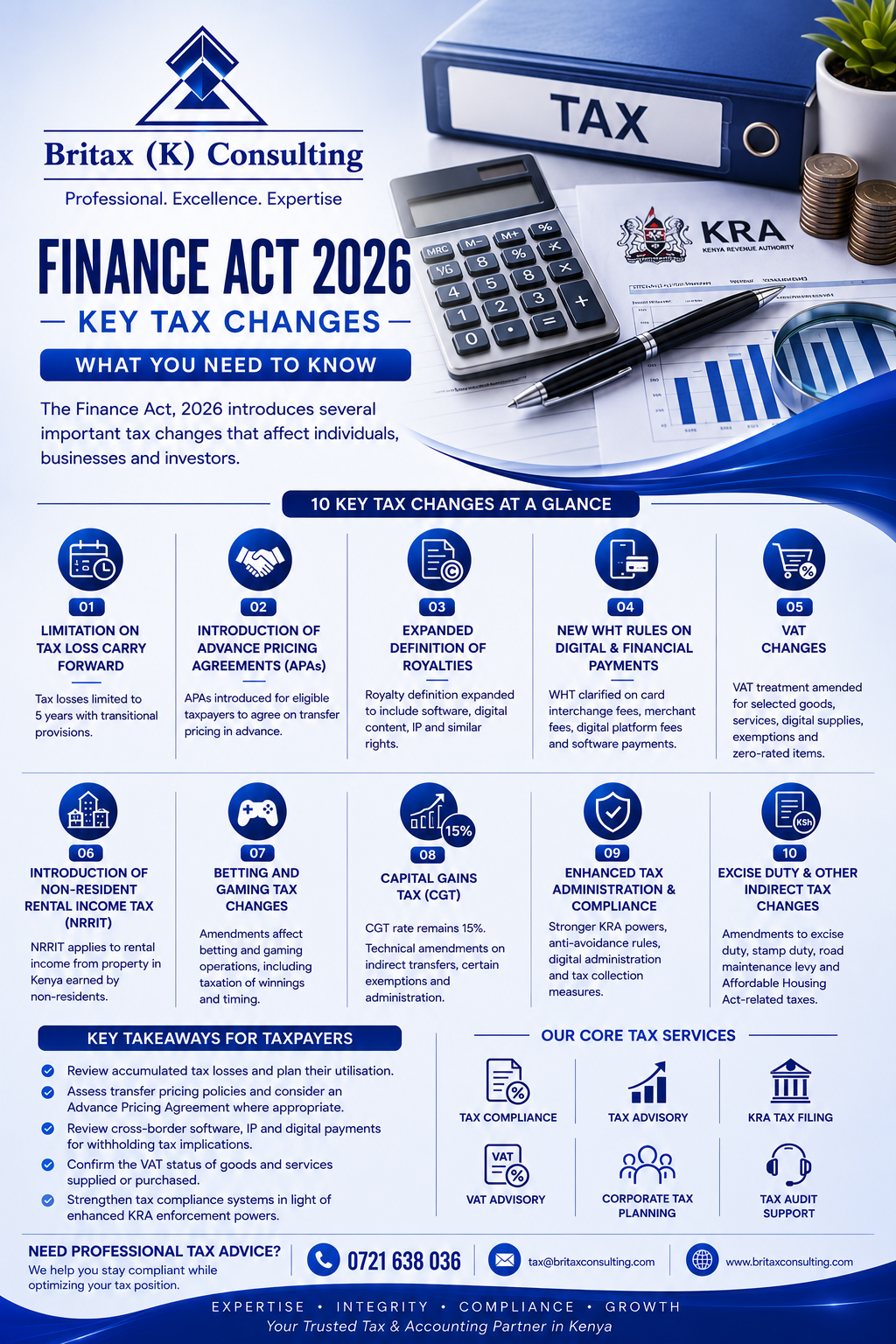

The Finance Act, 2026 was assented to on 23 June 2026, with most provisions taking effect from 1 July 2026. The Act introduces significant amendments to Kenya’s tax laws affecting businesses, investors, employers, multinational groups and non-resident taxpayers. Below is a summary of the key changes.
1. Limitation on Tax Loss Carry Forward
Tax losses could generally be carried forward indefinitely until fully utilized.
The Finance Act limits the carry-forward of tax losses to five years, subject to transitional provisions for qualifying taxpayers and investments.
Impact
✔ Businesses should review accumulated tax losses.
✔ Deferred tax assets may need reassessment.
✔ Companies should plan to utilise available losses within the permitted period.
2. Introduction of Advance Pricing Agreements (APAs)
Kenya had no statutory Advance Pricing Agreement framework.
The Finance Act introduces Advance Pricing Agreements (APAs), allowing eligible taxpayers and the Kenya Revenue Authority (KRA) to agree in advance on the transfer pricing methodology for related-party transactions.
Impact
✔ Greater certainty for multinational enterprises.
✔ Reduced transfer pricing disputes.
✔ Improved tax compliance for cross-border transactions.
3. Expanded Definition of Royalties
The definition of royalties was relatively narrow. The Act expands the definition of royalty income to include additional payments relating to software, digital content, intellectual property and similar rights.
Impact
✔ Businesses making cross-border payments should review withholding tax obligations.
✔ Certain software and digital payments may now attract withholding tax.
4. New Withholding Tax Rules on Digital and Financial Payments
Some digital payment-related fees were outside the withholding tax regime or subject to uncertainty. The Act clarifies the withholding tax treatment of certain payments, including:
Card interchange fees, Merchant service fees, Certain digital payment platform fees,Selected software-related payments
Impact
Businesses should review supplier payments to determine whether withholding tax is now applicable.
5. VAT Changes
Certain digital supplies and selected goods and services received different VAT treatment. The Finance Act amends the VAT treatment of selected goods and services, including certain digital supplies, exemptions and zero-rated items.
Impact
✔ Businesses should review whether their supplies remain taxable, exempt or zero-rated.
✔ VAT registration and compliance obligations may change for some taxpayers.
6. Introduction of Non-Resident Rental Income Tax (NRRIT)
Rental income earned by non-residents was taxed under the normal income tax regime.
The Finance Act introduces a Non-Resident Rental Income Tax (NRRIT) applicable to rental income derived from property situated in Kenya by non-resident persons.
Impact
✔ Foreign property owners will be subject to a dedicated tax regime.
✔ Property managers and tax agents should review compliance requirements.
7. Betting and Gaming Tax Changes
The Finance Act introduces amendments affecting betting and gaming operations, including changes to the taxation of winnings and the timing of taxation.
Licensed betting operators should review their withholding and reporting obligations.
8. Capital Gains Tax (CGT)
Capital Gains Tax applied at 15%. The Finance Act does not change the Capital Gains Tax rate, which remains 15%. However, the Act introduces technical amendments affecting:
Indirect transfers of Kenyan assets, Certain exemptions and Administration of CGT.
Impact
Investors should continue to factor CGT into property and share disposals while reviewing the new administrative provisions.
9. Enhanced Tax Administration and Compliance
The Finance Act strengthens the powers of the Kenya Revenue Authority through amendments to the Tax Procedures Act.
Key changes include:
✔ Enhanced compliance and enforcement measures.
✔ Stronger anti-avoidance provisions.
✔ Expanded use of digital tax administration.
✔ Improved tax collection mechanisms.
Impact
Businesses should strengthen record keeping, tax governance and compliance processes to minimise tax disputes.
10. Excise Duty and Other Indirect Tax Changes
The Act also introduces amendments affecting, Excise duty on selected products, Stamp Duty, Road Maintenance Levy, Affordable Housing Act-related tax provisions.
Businesses operating in affected sectors should review the new requirements to ensure compliance.
Key Takeaways for Taxpayers
✔ Review accumulated tax losses and plan their utilisation.
✔ Assess transfer pricing policies and consider an Advance Pricing Agreement where appropriate.
✔ Review cross-border software, intellectual property and digital payments for withholding tax implications.
✔ Confirm the VAT status of goods and services supplied or purchased.
✔ Strengthen tax compliance systems in light of enhanced KRA enforcement powers.
✔ Review investment structures in light of the updated Capital Gains Tax rules.
Need assistance?
Britax (K) Consulting provides expert advisory services on:
✔ Tax Compliance
✔ Corporate Tax
✔ VAT
✔ PAYE
✔ Transfer Pricing
✔ Capital Gains Tax
✔ Tax Health Checks
✔ KRA Audits & Dispute Resolution
✔ International Tax Advisory
Contact Britax (K) Consulting today for professional guidance on how the Finance Act, 2026 affects your business.


